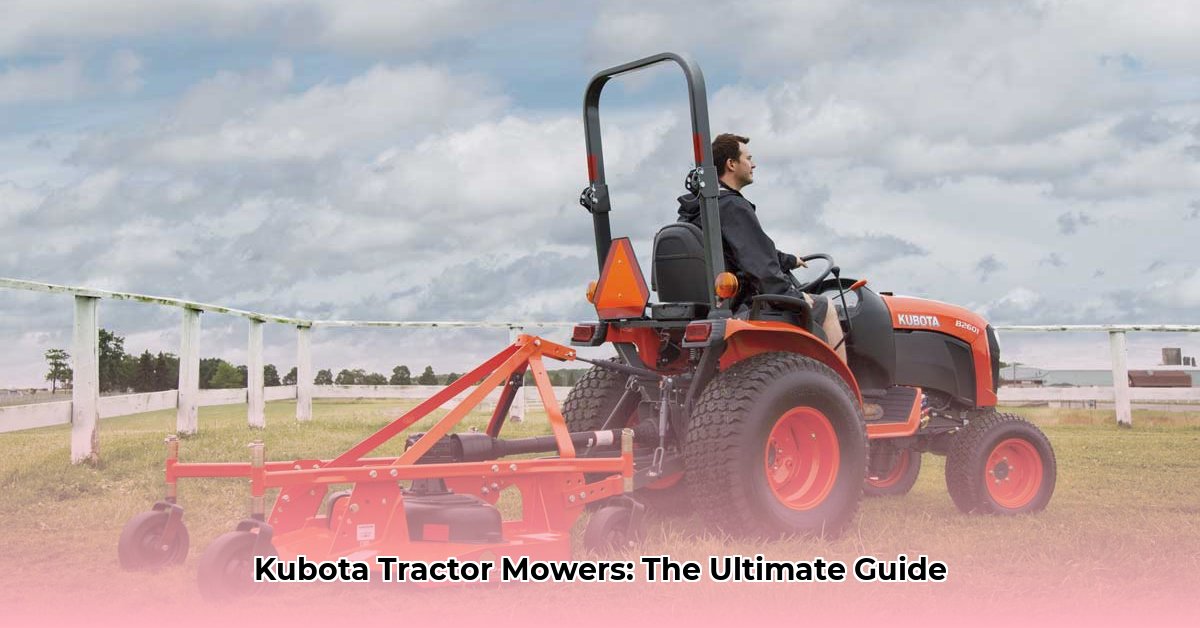
Finding the right mower for your Kubota tractor is crucial for efficient and sustainable agricultural practices. This guide provides actionable insights to help you choose the ideal mower for your needs, focusing on minimizing environmental impact and maximizing operational efficiency. For more options, check out these zero turn mowers.
Understanding Your Mowing Needs: Beyond Cutting Grass
Before selecting a mower, assess your specific requirements. What are your primary goals? Are you maintaining a small lawn, managing a large pasture, or preparing fields for planting? Several key factors determine the best mower choice:
- Acreage: The size of your mowing area directly impacts the required mower capacity and efficiency. Larger areas necessitate more powerful and larger cutting width mowers.
- Terrain: Hilly or uneven terrain requires a mower built for stability and maneuverability. Steep slopes might necessitate a mower specifically designed for such conditions.
- Vegetation: The type of vegetation dictates the appropriate mower type. Dense brush or heavy growth requires a more robust mower than delicate turf.
Kubota Mowers: Exploring Your Options
Kubota offers various mower types, each designed for specific applications. Understanding these differences is key to selecting the right tool for the job.
Rotary Mowers: These mowers use a spinning blade to cut grass, similar to a standard lawnmower. They're versatile and generally efficient for most lawns and pastures, offering a balance of speed, ease of use, and affordability. However, they might struggle with very thick or wet vegetation.
Flail Mowers: Utilizing multiple swinging flails, flail mowers excel in challenging conditions. They're ideal for rough terrain, dense vegetation, and brush clearing due to their ability to mulch effectively. While less precise than rotary mowers, their superior mulching capabilities promote soil health.
Disc Mowers: Designed for high-speed mowing across vast areas, disc mowers are powerful machines ideal for large-scale operations. Their high capacity is offset by their demanding horsepower requirements and reduced versatility compared to other types.
Here's a comparative table summarizing these mower types within the context of sustainable agriculture:
| Mower Type | Sustainable Agriculture Advantages | Sustainable Agriculture Disadvantages | Ideal Applications |
|---|---|---|---|
| Rotary | Versatile, relatively low maintenance, efficient for smaller areas | Can scalp turf, less efficient on large areas or dense growth | Lawns, pastures, relatively flat land with moderate vegetation |
| Flail | Excellent mulching, handles tough conditions, promotes soil health | Higher maintenance, higher initial cost | Rough terrain, dense vegetation, brush clearing |
| Disc | High capacity, efficient for large-scale mowing | High horsepower requirements, less versatile, potential soil compaction | Large fields, high-speed mowing of uniform vegetation |
Choosing the Right Mower: A Step-by-Step Guide
Selecting the optimal Kubota mower involves a systematic approach. Follow these steps for a confident decision:
Assess Your Land: Conduct a thorough assessment of your mowing area, noting its size, terrain, and vegetation type. Detailed measurements and photographic documentation will prove invaluable for comparison.
Define Your Budget: Establishing a realistic budget encompassing both initial purchase costs and ongoing maintenance is crucial. Unexpected expenses can severely impact the sustainability of your operations.
Check Tractor Horsepower: Ensure your Kubota tractor possesses sufficient horsepower to operate the chosen mower efficiently and safely. Underpowering the mower leads to reduced performance and potential damage to both the tractor and mower.
Prioritize Sustainability: Consider fuel efficiency, mulching capabilities, and the environmental impact of your mower choices. Mulching capabilities reduce the need for fertilizers, promoting soil health.
Demo and Compare: If feasible, schedule demonstrations with different mowers to gain hands-on experience. This allows for a direct comparison of performance nuances and ease of operation.
Safe Operation and Maintenance: Essential for Longevity
Proper operation and maintenance are critical for ensuring the longevity and optimal performance of your Kubota mower. Always refer to your owner's manuals for precise instructions.
Regular Inspections: Regularly inspect your mower for wear and tear, ensuring the timely detection and resolution of any potential mechanical issues. Preventive maintenance significantly extends lifespan and reduces downtime.
Blade Sharpness: Maintain sharp blades for clean cuts and efficient operation. Dull blades compromise efficiency, increase wear and tear, and contribute to uneven mowing.
Responsible Waste Disposal: Dispose of clippings and waste materials responsibly to minimize environmental impact. Local regulations dictate proper disposal methods.
Optimizing Mowing for Sustainability: Beyond the Machine
Sustainable mowing practices extend beyond mower selection. Consider these key aspects:
Cutting Height: Adjust cutting height to promote healthy root systems and minimize soil compaction. Higher cutting heights generally result in healthier turf.
Mulching: Utilize mulching mowers to return finely chopped grass clippings to the soil, nourishing it and reducing reliance on chemical fertilizers.
Efficient Routing: Plan mowing routes to minimize fuel consumption and reduce overlaps. Efficient routing directly translates to reduced operational costs and lessened impact on the environment.
Soil Compaction: Minimize soil compaction through careful maneuvering and avoiding mowing when soil is wet.
By combining the right mower with sustainable practices, you achieve efficient land management and a healthier environment. Remember, choosing the right mower is only the first step on your path towards sustainable agricultural practices.